Your Paired Scientist
You open your draft and find tracked changes from someone who actually read the whole thing. A short stack of papers you hadn’t seen yet. And none of it rushed.
Science isn’t a sprint. It’s questioning, sitting with it, testing, circling back. That rhythm matters, and it’s how real discoveries hold up. We built sciClaw to work that way, not to push you faster. And everything about how it operates lives in plain text files on your computer. No mystery. You can read every one of them.
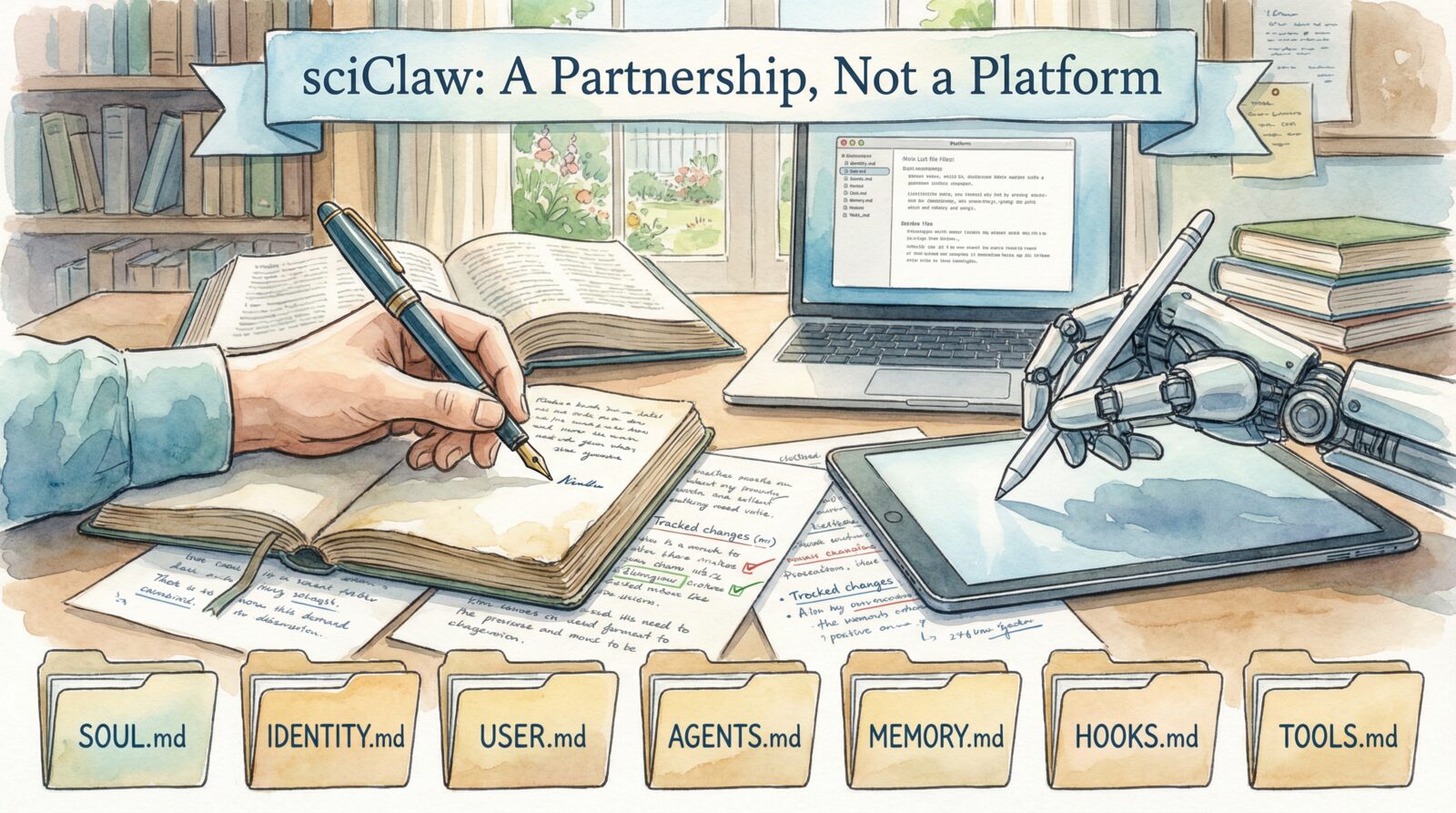
A Partnership, Not a Platform
Most AI tools want you to log into their world. Upload your data, follow their workflow, trust their servers. sciClaw flips that. It runs on your machine, in your folder, under your control.
It does the things computers are genuinely good at: combing through PubMed, drafting a methods section, keeping a meticulous log. The rest (the reasoning, the judgment calls, the instinct for what matters) stays with you.
Everything lives in ~/sciclaw. Plain files you can version with git, share with a collaborator, or audit on a Sunday morning. You teach it your protocols in simple markdown. Honestly, it’s a lot like onboarding a new postdoc, except this one never forgets what you told it.
You Shape It with Plain Text
There’s no hidden configuration. No admin panel. sciClaw’s personality, boundaries, and knowledge come from markdown files you edit like any other document in your workspace:
SOUL.md is the conscience. Where you spell out what matters: epistemic humility, reproducibility over convenience, being honest about uncertainty. IDENTITY.md tells it who it is, your lab’s research partner, not some generic chatbot trying to be helpful.
USER.md is about you. How you like to communicate, which journal you’re targeting, how deep you want the evidence summaries. AGENTS.md lays out the research loop: frame a question, propose a plan, run the tools, update what you know. Basically the scientific method, written down.
MEMORY.md works like a lab notebook that carries over between sessions. Your active hypotheses, things you’ve ruled out, open questions, confidence levels for each. Come back a month later and the thread is still there. HOOKS.md makes sure every tool call, every decision point, every stumble gets captured in an audit trail you can always go back to.
And TOOLS.md keeps the agent honest about how it uses its capabilities. Tools serve the methodology, operations should be reversible, and every output ties back to the evidence behind it.
Seven files. You can read all of them. Change any of them. That’s the whole system.
The Scientist’s Cadence
Biology doesn’t move at startup speed. It’s iterative, cautious, built on reproducing what came before. Most tech tools don’t get that. They’re designed for people who ship fast and fix later.
sciClaw was built for the other kind of work. Tracked edits in your Word document. Provenance logs so you know where a finding came from. Citation chains you can follow end to end. Six months from now, you can retrace exactly how a result emerged. That’s the kind of trust you actually need.
Humans + Machines: Complementary Strengths
Machines are good at crunching. Humans are good at meaning. The best work happens when AI stays in its lane and lets you stay in yours.
That’s how sciClaw works. You set the guardrails in SOUL.md. You define what you care about in USER.md. You track your thinking in MEMORY.md. The agent does its job reliably inside those lines. It’s an extension of you, not a replacement for the parts that matter most.
Open source. Free. Yours to shape however you need. Science has always moved forward through good partnerships. This is one more.